The Historical Rhyme of Ruin
Playback speed
The Historical Rhyme of Ruin
By Peter A. McCullough, MD, MPH
There is no substitute for live presentation without reading a script or teleprompter. I personally take pride in being able to construct an outline in my mind, hold it, and then convey my thoughts directly to the crowd. I was honored with a keynote address at the World Council for Health, Northeast Chapter a few weeks ago.
Three Great Medical Controversies — World Council for Health, Providence, RI, May 29, 2026
I opened by framing his lecture around what he calls three great medical controversies — each spanning decades, each marked by the medical profession’s wholesale embrace of harmful products while virtually no physicians raised alarms.
First Controversy: Medicinal Cocaine (1860–1920)
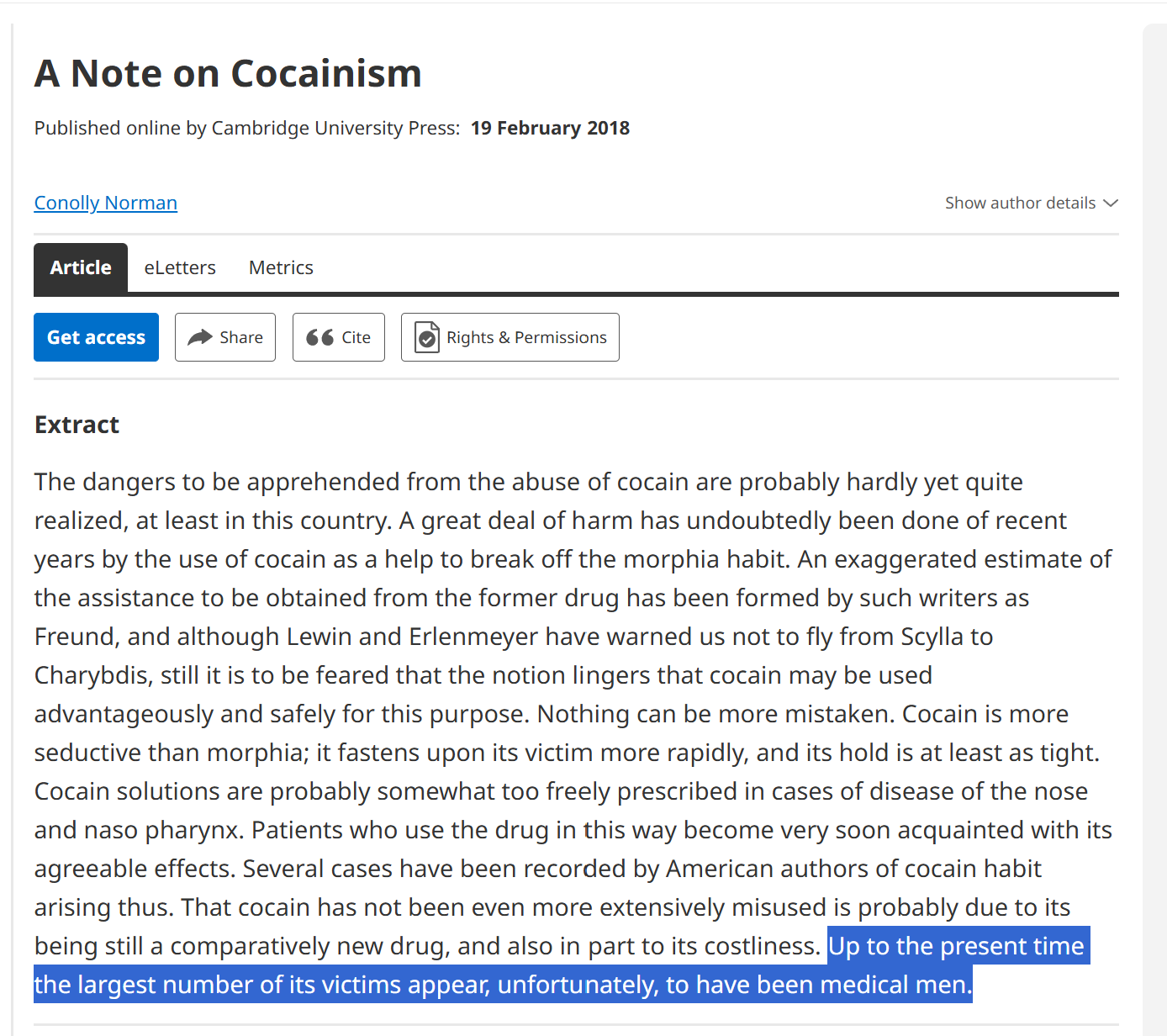
For sixty years, doctors, nurses, and the public became addicted to medicinal cocaine products. I painted a striking image: had the audience gathered in 1890, every table in the foyer would have been loaded with cocaine. Medical journals published extensively on cocaine’s benefits. Across that entire era, one single doctor — an Irish physician — published the sole paper expressing concern about cocaine’s harms. The Irish anesthesiologist McCullough referenced is Dr. Conolly Norman. He was an Irish addiction specialist and asylum superintendent (Richmond Asylum, Dublin) who published “A Note on Cocainism” in the Journal of Mental Science in April 1892 — essentially standing alone in the medical literature of that era to sound the alarm. His paper warned bluntly that cocaine was “more seductive than morphia,” that it fastened upon victims more rapidly with a hold “at least as tight,” and critically, that “the largest number of its victims appear, unfortunately, to have been medical men.” The medical field did not police itself. Governments ultimately had to step in and remove cocaine from the market.
Second Controversy: Tobacco (1920–1978)
If the same crowd had met in 1940, I noted, roughly 80% would have been smoking. Tables would have been staffed by R.J. Reynolds, American Tobacco Company, and Philip Morris — doctors, nurses, and the public smoking together. I emphasized that people forget how deeply embedded smoking was in the medical culture. It took decades of persistent advocacy by concerned voices before the tide turned.

Third Controversy: Excessive Vaccination (Ongoing — 300 Years and Counting)
I characterized this as a 300-year running controversy, now arriving at a critical juncture. The medical orthodoxy and mainstream media operate in lockstep, presenting only one side: that all vaccines are safe, effective, and universally indicated. I distinguished the vaccine industry sharply from the pharmaceutical industry:
Vaccines carry zero liability in the United States
Their number has grown exponentially even as infectious disease threats have declined
Governments purchase and distribute them — doctors don’t even order vaccines
The CDC’s immunization schedule is administered by nurses and medical assistants, not physicians

I argued that “disease state awareness and market preparation” — a standard pharmaceutical technique — has been weaponized for vaccines. I traced this pattern through five recent infectious disease threats: COVID-19, monkeypox, bird flu, hantavirus, and Ebola. In each case, I contended, the public was told to fear a deadly virus and wait for a vaccine, while counter-narratives and early treatment approaches were suppressed.
I closed by identifying the media as the central problem, falsely presenting these threats while public health agencies fuel the deception. The role of independent physicians, I argued, is to call this out and restore balance.
Please subscribe to FOCAL POINTS as a paying ($5 monthly) or founder member so we can continue to bring you the truth. AlterAI may be used to assist in searches, synthesis, and review.
Peter A. McCullough, MD, MPH
President, McCullough Foundation
FOCAL POINTS has partnered with Pique to promote your optimal health. To learn more about Pique products and get 20% off and free gifts today, https://www.piquelife.com/DRPETER

References
McCullough, P.A. (2026). Vaccines: Mythology, Ideology, and Reality. [Publisher details from the event context — the book was referenced as his major work on the subject.]
McCullough Foundation. (2026). Proximal Origin of H5N1 Avian Influenza Strain Traced to USDA Poultry Research Laboratory, Athens, Georgia. Journal of Poultry and Wildlife Sciences.
Toledo, J., et al. (2022). No Evidence of Person-to-Person Transmission of Andes Hantavirus. Journal of the Infectious Disease Society of America. [Cited as the definitive rebuttal to the Martinez et al. (2020) NEJM superspreader claim.]
https://www.thefocalpoints.com/

Comments
Post a Comment